| Andorra | Austria | Belgium |
|---|---|---|
 |  |  |
| Bulgaria | Croatia | Cyprus |
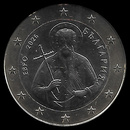 |  |  |
| Estonia | Finland | France |
 |  |  |
| Germany | Greece | Holland |
 |  |  |
| Ireland | Italy | Latvia |
 |  |  |
| Lithuania | Luxembourg | Malta |
 |  |  |
| Monaco | Portugal | San Marino |
 |  |  |
| Slovakia | Slovenia | Spain |
 |  |  |
| Vatican | ||
 |

The ordinary series of euro coins includes eight denominations: 1, 2, 5, 10, 20 and 50 cents, 1 and 2 euros. The issues are national, with a common European side and a national side.
As regards the metal with which the coins are made, it is possible to distinguish three groups of coins:
- 1, 2 and 5 cents are made of copper-plated steel;
- the 10 cent, 20 cent and 50 cent euros, made of an alloy of 89% copper, 5% aluminium, 5% zinc and 1% tin, called Nordic gold;
- the 1 euro and 2 euro bimetallic coins, with the silver part (inside of the 1 euro coins and outside of the 2 euro coins) made with a copper-nickel alloy while the golden part (outside of the 1 euro coins and inside of the 2 euro coins) with a nickel-brass alloy.
The common side, designed by Luc Luycx of the Belgian Mint, presents the value and a geographical representation. Since 2007, on denominations from 10 cents to 2 euros, the new card shows Europe without the previous borders between member states. The twelve stars recall the European flag, not twelve founding countries.
The national side features subjects chosen by the issuing country. From 1 January 2026, with the entry of Bulgaria, the European Union countries that have adopted the euro are 21. Added to them are Andorra, Monaco, San Marino and the Vatican, authorized by monetary agreements to issue their own currencies. Kosovo and Montenegro instead use the euro without their own national faces.
The common rules provide for the identification of the issuing country and the twelve stars of the European flag. The national designs were updated at different times, also due to changes in sovereigns: not all countries changed series in the same year.
As regards the characteristics of each coin, we have:
- the 1 euro cent coins have a steel part with a weight of 94.35%, while the copper part has a weight of 5.65%; the diameter of the coin is 16.25 mm, the thickness of 1.67 mm, the weight of 2.30 g and the smooth edge;
- the 2 euro cent coins have a steel part with a weight of 94.44%, while the copper part has a weight of 5.56%; the diameter of the coin is 18.75 mm, its thickness is 1.67 mm, the weight is 3.06 g and the smooth edge with a central groove;
- the 5 euro cent coins have a steel part with a weight of 94.64%, while the copper part has a weight of 5.36%; the diameter of the coin is 21.75 mm, 1.67 mm thick, weighs 3.92 grams and has a smooth edge;
- the 10 euro cent coins are minted in an alloy called Nordic gold, they are 19.75mm in diameter, 1.93mm thick, 4.10 g in weight and have a lined edge;
- the 20 euro cent coins are minted in Nordic gold like the 10 cent and 50 cent coins, they have a diameter of 22.25 mm, a thickness of 2.14 mm, a weight of 5.74 g and a smooth edge, but have seven indentations in a configuration known as the "Spanish flower";
- the 50 euro cent coins are in Nordic gold, have a diameter of 24.25mm, a thickness of 2.38mm, a weight of 7.80g and a lined edge;
- 1 euro coins are bimetallic with the silvery interior made of a copper-nickel alloy, while the golden exterior is made of a nickel-brass alloy; their diameter is 23.25mm, the thickness is 2.33mm, the weight is 7.50g and the edge has 6 segments, with 3 smooth segments alternating with 3 finely lined segments;
- the 2 euro coins are bimetallic with the golden interior in a nickel-brass alloy, while the silver exterior in a copper-nickel alloy; their diameter of 25.75 mm, the thickness of 2.20 mm, the weight of 8.50g and the finely lined edge with engraved writing that differs from country to country.
In some countries, including Finland and the Netherlands, rounding total cash payments to the nearest five cents reduces the use of 1 and 2 cent denominations. Rounding does not eliminate its legal tender status: it is necessary to distinguish the use in payments from national minting policies.
Some examples of inscriptions on the edge of the 2 euros:
- Austria: the writing "2 EURO ***" repeated 4 times, turning it upside down at each repetition;
- Belgium, France, Ireland, Luxembourg, Monaco, Spain: the writing "2 * *" repeated 6 times, turning it upside down at each repetition;
- Cyprus: the writing "2 ΕΥΡΟ 2 EURO" ("euro" in Greek and Turkish) repeated 2 times;
- Finland: the writing "SUOMI FINLAND" ("Finland" in Swedish and Finnish) followed by 3 lion heads;
- Germany: the phrase "EINIGKEIT UND RECHT UND FREIHEIT" ("Unity and Justice and Freedom" in German) followed by the heraldic eagle.
- Greece: the phrase "ΕΛΛΗΝΙΚΗ ΔΗΜΟΚΡΑΤΙΑ *" ("ELLENIKE DEMOKRATIA", i.e. "GREEK REPUBLIC" in Greek;
- Italy, San Marino, Vatican City: the writing "2 *" repeated 6 times, turning it upside down at each repetition;
- Malta: the sequence of the number "2" and two Maltese Crosses, repeated 6 times, reversing it at each repetition;
- Netherlands: the phrase "GOD * ZIJ * MET * ONS *" ("God be with us" in Dutch);
- Portugal: a sequence of 7 castles and 5 shields;
- Slovenia: the word "SLOVENIJA" ("Slovenia" in Slovenian), followed by a period.
In addition to coins for normal circulation and coins for collectors, various 2 euro commemorative coins have also been minted by different nations, which commemorate events or people of interest for each country or for the European Union as a whole.
European Commission link:
See also: European Union.
Source: ECB: common faces and characteristics of coins.
Source: European Union: meaning of the twelve stars.